In the dynamic world of marketing, understanding the customer journey is paramount to success. It’s rarely a linear path; instead, potential customers move through various stages, from initial awareness to becoming loyal advocates for your brand. This journey is most effectively visualized and managed through the concept of a marketing funnel.
Far more than just a theoretical model, a well-defined marketing funnel is a strategic framework that allows businesses to understand customer behavior, tailor marketing efforts, and ultimately drive conversions and foster long-term relationships. It provides a roadmap for guiding prospects, ensuring the right message reaches the right person at the right time.
What is a Marketing Funnel?
Imagine a literal funnel. Wide at the top, narrow at the bottom. In marketing funnel terms, it’s a visual representation of the journey a potential customer takes, from their very first interaction with your brand all the way to becoming a paying customer. It’s a strategic framework that helps you understand and optimize each step of that journey. Think of it as your customer’s guided tour!
At its core, a marketing funnel is a visual representation of the steps a potential customer takes when interacting with your business, from the moment they become aware of your existence to the point of making a purchase and beyond. The funnel shape illustrates the natural progression: a wide top encompassing a large audience, narrowing down to a smaller group of converted customers at the bottom.
Think of it as a filter. You start with a broad pool of potential leads and, through targeted marketing activities, you nurture and qualify them, moving them further down the funnel until they are ready to become paying customers.
Why is the Marketing Funnel Crucial?
Implementing and understanding a marketing funnel offers numerous benefits for businesses of all sizes:
- Provides Clarity on the Customer Journey: It helps visualize and understand the different touchpoints and decision-making processes customers go through.
- Identifies Bottlenecks: By tracking prospects at each stage, you can pinpoint where potential customers are dropping off, indicating areas for improvement in your marketing strategy.
- Aligns Marketing and Sales Efforts: The funnel provides a shared language and framework for both teams, ensuring a cohesive approach to lead nurturing and conversion.
- Optimizes Resource Allocation: Understanding which marketing activities are most effective at each stage allows for more efficient allocation of budget and resources.
- Improves Conversion Rates: By addressing customer needs and providing relevant information at each stage, you increase the likelihood of conversion.
- Facilitates Measurement and Analysis: The funnel provides clear stages to track key metrics, allowing for data-driven decision-making and continuous optimization.
The Stages of the Marketing Funnel
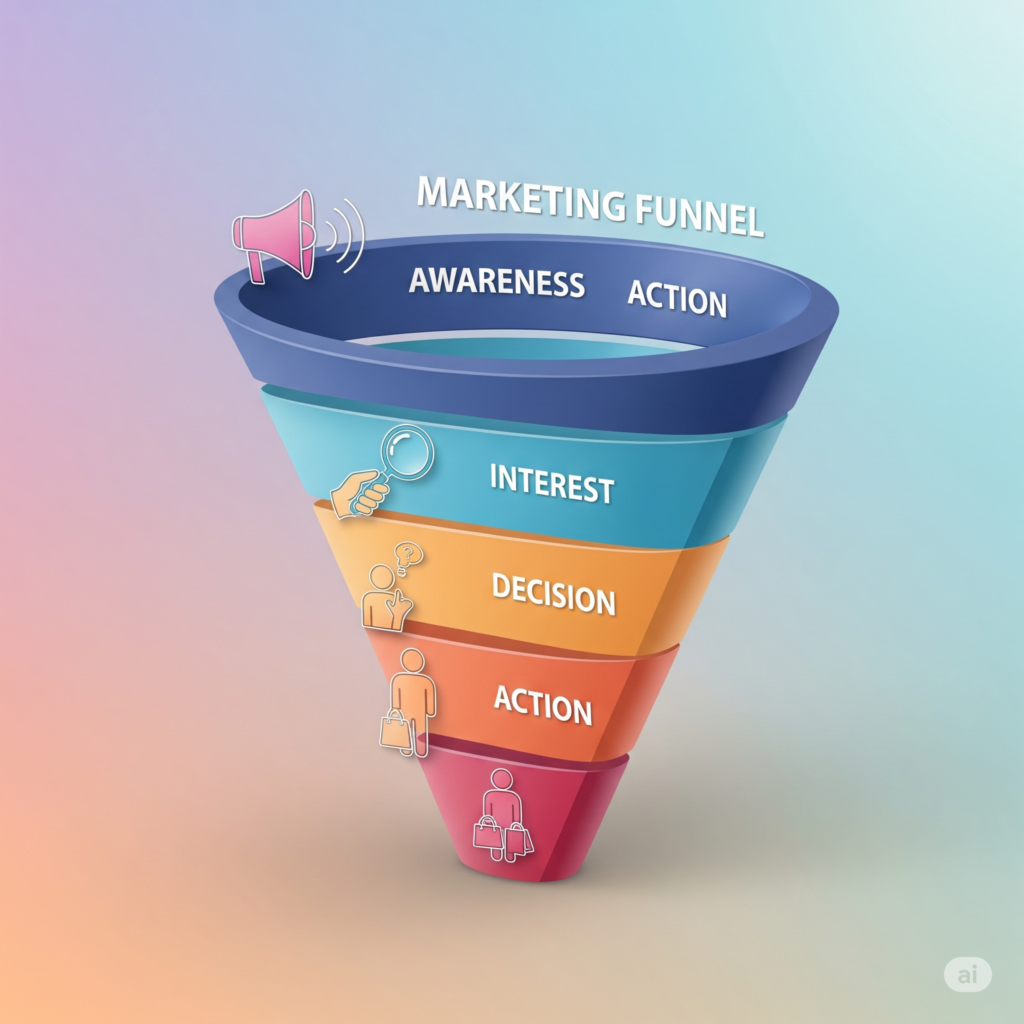
While the terminology might vary slightly, most marketing funnels include several core stages that represent the customer’s evolving relationship with your brand. A commonly used model, often referred to as AIDA, includes:
-
Awareness (Top of the Funnel – TOFU): This is the widest part of the funnel where potential customers first become aware of your brand, product, or service. They might have a problem or need and are starting to look for solutions, or they might simply stumble upon your brand through various channels.
- Customer Mindset: “I have a problem” or “What is this?”
- Marketing Activities: Blog posts, social media content, search engine optimization (SEO), paid advertising, content marketing, public relations, influencer marketing. The goal here is to attract a broad audience and make them aware of your existence and how you can potentially help them.
-
Interest (Middle of the Funnel – MOFU): At this stage, prospects have moved beyond initial awareness and are showing interest in learning more about your offerings and how they can address their specific needs. They are actively seeking information and exploring potential solutions.
- Customer Mindset: “Tell me more about potential solutions” or “How can this help me?”
- Marketing Activities: Webinars, e-books, guides, whitepapers, comparison guides, email marketing (nurturing sequences), targeted landing pages, social media engagement, retargeting ads. The focus is on educating prospects and building trust by providing valuable and relevant information.
-
Decision (Middle of the Funnel – MOFU): In this stage, interest deepens into desire. Prospects begin to develop a preference for your solution over others. They understand the value proposition and start to envision themselves using your product or service.
- Customer Mindset: “I like this option” or “This could be the right fit for me.”
- Marketing Activities: Case studies, testimonials, product demos, free trials, consultations, detailed product pages, social proof (reviews and ratings), personalized email sequences highlighting benefits. The aim is to build a strong case for why your offering is the best solution.
-
Action (Bottom of the Funnel – BOFU): This is the narrowest part of the funnel where the prospect is ready to make a decision and take action, typically leading to a conversion (e.g., making a purchase, signing up for a service, contacting sales).
- Customer Mindset: “I am ready to buy” or “How do I get started?”
- Marketing Activities: Clear calls to action (CTAs), easy-to-navigate checkout processes, special offers or discounts, personalized recommendations, live chat support, dedicated sales interactions (for B2B). The objective is to remove any barriers and facilitate the conversion.
Beyond the initial conversion, many modern marketing funnel models also include stages focused on customer retention and advocacy:
-
Loyalty: After becoming a customer, the focus shifts to fostering loyalty and encouraging repeat business.
- Marketing Activities: Post-purchase follow-up, loyalty programs, exclusive content for customers, excellent customer service, personalized offers.
-
Advocacy: Loyal customers become brand advocates, actively recommending your products or services to others.
- Marketing Activities: Referral programs, encouraging reviews and testimonials, building a brand community, engaging with customers on social media.
Types of Marketing Funnels
While the core AIDA or TOFU/MOFU/BOFU model is prevalent, marketing funnels can be adapted and specialized based on business goals and models. Some examples include:
- Lead Generation Funnel: Focused on capturing lead information (e.g., email addresses) through valuable content offers.
- Sales Funnel: Often used interchangeably with marketing funnel, but can sometimes refer specifically to the stages managed by the sales team after a lead is qualified.
- Webinar Funnel: Designed to drive registrations and attendance for a webinar, with the goal of converting attendees into leads or customers.
- E-commerce Funnel: Maps the customer journey on an online store, from Browse to checkout.
- SaaS Funnel: Tailored for Software as a Service businesses, focusing on free trials, demos, and subscription conversions.
Building and Optimizing Your Marketing Funnel
Creating an effective marketing funnel involves several key steps:
- Understand Your Target Audience: Deeply research your ideal customer personas, their needs, pain points, and online behavior.
- Map the Customer Journey: Outline the steps your target audience takes from initial awareness to conversion and beyond. Identify the touchpoints at each stage.
- Define Your Funnel Stages: Based on the customer journey, clearly define the stages of your marketing funnel and the goals for each stage.
- Create Targeted Content and Marketing Activities: Develop content and execute marketing campaigns specifically designed to engage and move prospects through each stage of the funnel.
- Set Up Tracking and Analytics: Implement tools to track key metrics at each stage of the funnel.
- Analyze and Optimize: Regularly analyze your funnel performance, identify bottlenecks, and continuously test and optimize your strategies and tactics based on the data.
How to Create a Marketing Funnel
Creating a successful marketing funnel isn’t rocket science, but it does require thought:
- Define Your Audience: Who are you trying to reach? What are their pain points?
- Map the Customer Journey: How do your ideal customers typically interact with your brand at each stage?
- Choose Your Channels: Where will you reach your audience at each stage (social media, email, website, etc.)?
- Create Engaging Content: Develop compelling content tailored to each funnel stage.
- Set Up Tracking: How will you measure success at each step?
- Test and Optimize: Continuously analyze your data and make adjustments.
Marketing Funnel Metrics
To truly understand the health of your digital marketing funnel, you need to track key metrics. These include:
- Website Traffic: How many people are entering the top of your funnel?
- Lead Generation Rate: How many visitors are converting into leads?
- Conversion Rate: What percentage of leads are becoming customers?
- Customer Lifetime Value (CLTV): How much is a customer worth to your business over time?
- Cost Per Acquisition (CPA): How much does it cost to acquire a new customer?
Strategies for Each Stage of the Marketing Funnel
Each stage demands specific strategies to guide your potential customers smoothly through your funnel marketing:
- Awareness: Focus on broad reach. Think informative blog posts, engaging social media content, search engine optimization (SEO), and paid advertisements.
- Interest: Provide valuable, in-depth content. Offer free guides, webinars, email newsletters, and interactive quizzes.
- Consideration: Build trust and demonstrate value. Share case studies, customer testimonials, product comparisons, and offer free trials or demos.
- Decision: Make it easy to convert. Use clear calls to action, offer limited-time discounts, provide excellent customer support, and ensure a seamless checkout process.
- Retention/Advocacy: Nurture relationships. Send personalized emails, offer loyalty programs, ask for feedback, and encourage reviews and referrals.
The Difference Between B2B and B2C Marketing Funnels
While the core concept of a funnel remains the same, there are key differences:
- B2C (Business-to-Consumer): Often shorter, more emotional decisions, driven by impulse and immediate needs. The sales funnel can be quicker.
- B2B (Business-to-Business): Generally longer, more complex, and involves multiple stakeholders. Decisions are typically logical, research-driven, and require more nurturing. The digital marketing funnel for B2B often involves more touchpoints.
What’s the difference between marketing funnels and sales funnels?
This is a common question! While often used interchangeably, there’s a subtle distinction:
- Marketing Funnel: Focuses on attracting, engaging, and nurturing leads until they are sales-qualified. It’s about building interest and preparing potential customers.
- Sales Funnel: Kicks in once a lead is ready to be directly engaged by the sales team. It’s about closing the deal, handling objections, and facilitating the purchase.
Think of it this way: the marketing funnel feeds the sales funnel. Both are crucial for overall business growth, and often blend seamlessly in practice. Understanding what are sales funnels in relation to marketing is key.
How to measure the success of your marketing funnel
Measuring success isn’t just about tracking individual metrics; it’s about looking at the entire journey:
- Conversion Rates at Each Stage: Are people moving smoothly from awareness to interest, and so on?
- Time in Funnel: How long does it take for a lead to convert?
- Lead Quality: Are the leads generated at the top of the marketing funnel truly qualified for sales?
- ROI of Marketing Efforts: Are your marketing investments yielding positive returns?
- Customer Feedback: Are customers happy with their experience?
4 Tools to Increase Conversion Rates Throughout Your Funnel
To optimize your funnels and boost conversions, consider these types of tools:
- Email Marketing Platforms: For nurturing leads, sending targeted content, and automating follow-ups (e.g., Mailchimp, HubSpot).
- CRM (Customer Relationship Management) Software: To manage leads, track interactions, and ensure no potential customer falls through the cracks (e.g., Salesforce, Zoho CRM).
- Analytics Tools: To track website traffic, user behavior, and conversion rates, giving you insights into what’s working and what isn’t (e.g., Google Analytics, Hotjar).
- Landing Page Builders: To create high-converting landing pages for specific offers and campaigns (e.g., Unbounce, Leadpages).
In conclusion, understanding and actively managing your marketing funnel is not just a marketing best practice; it’s a fundamental strategy for sustainable business growth. By focusing on each stage, providing value, and continuously optimizing, you’ll be well on your way to turning more prospects into loyal customers. So, go forth and build your powerful funnel!
Key Marketing Funnel Metrics to Track
To effectively measure and optimize your marketing funnel, it’s essential to track relevant metrics at each stage:
-
Awareness:
- Website Traffic (Organic, Direct, Referral, Paid)
- Brand Mentions
- Social Media Reach and Impressions
- Earned Media
-
Interest & Desire:
- Lead Magnet Downloads
- Webinar Registrations/Attendance
- Email Sign-ups
- Time on Page/Site
- Bounce Rate
- Social Media Engagement (Likes, Shares, Comments)
- Click-Through Rates (CTR) on Ads and Emails
-
Action:
- Conversion Rate (Overall and by Channel)
- Cost Per Acquisition (CPA)
- Average Order Value (AOV)
- Sales Revenue
-
Loyalty & Advocacy:
- Customer Retention Rate
- Customer Lifetime Value (CLV)
- Repeat Purchase Rate
- Net Promoter Score (NPS)
- Referrals
Conclusion
The marketing funnel is a fundamental concept for any business looking to grow and succeed in the digital age. By understanding the stages of the customer journey, tailoring your marketing efforts accordingly, and continuously analyzing your performance, you can effectively guide prospects towards conversion and build lasting customer relationships. Building and optimizing your marketing funnel is an ongoing process, but the insights gained and the results achieved are invaluable for sustainable business growth. Start by mapping your customer’s journey today and watch your efforts transform into tangible results.